
Introduction
If you searched for an SEO guide 2026 because you’re tired of vague advice and outdated tricks, you’re in the right place. SEO hasn’t disappeared — but it has changed shape. Google now answers a huge share of queries directly through AI Overviews, more people are asking ChatGPT and Perplexity instead of typing into a search box, and “just publish more content” stopped working years ago.
None of that means SEO is dead. It means the bar for what counts as good SEO has gone up. This guide walks you from the absolute basics through advanced 2026-specific strategies, with checklists and examples you can actually use — whether you’re optimizing your first blog post or rebuilding a content strategy that’s stopped converting.
By the end, you’ll understand:
- How search engines (and AI answer engines) actually decide what to rank
- The on-page, technical, and off-page fundamentals that never go out of style
- What’s genuinely new in 2026 and worth your time
- Which tools are worth paying for
Let’s start from the ground up.
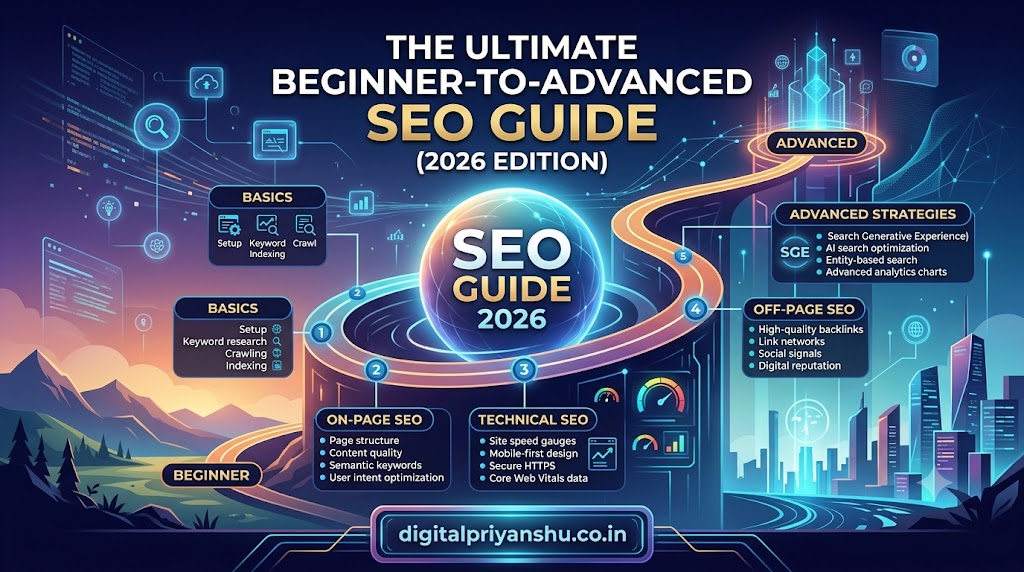
SEO Basics: What You Actually Need to Understand First
What Is SEO, Really?
Search Engine Optimization is the practice of shaping your website so that search engines — and increasingly, AI systems — can understand what it’s about, trust it, and recommend it to people looking for answers. That’s it. Everything else is technique in service of that one idea.
How Search Engines Decide Rankings
Google (and Bing, and the large language models pulling from the web) look at three broad questions when deciding what to show someone:
- Relevance — Does this page actually answer the query?
- Quality and trust — Is this a credible source written by someone who knows what they’re talking about?
- Experience — Is the page fast, usable, and pleasant to read on any device?
The Three Pillars of SEO
- On-Page SEO — What’s on the page itself (content, keywords, structure)
- Technical SEO — How the site is built (speed, crawlability, code)
- Off-Page SEO — What happens elsewhere that signals your credibility (links, mentions, reputation)
Beginner Checklist
- Set up Google Search Console and Google Analytics (or an equivalent)
- Identify your 5 most important target pages
- Confirm your site is mobile-friendly
- Make sure your site loads in under 3 seconds
- Write one piece of content around a real question your audience is asking
On-Page SEO: Optimizing What’s On the Page
On-page SEO is where most beginners start, and it’s still where a lot of ranking potential is won or lost.
Keyword Research That Isn’t Guesswork
Forget stuffing “SEO guide 2026” into every sentence. Instead:
- Look for the actual phrases people type or speak into search
- Group keywords by intent: informational (“what is technical SEO”), commercial (“best SEO tools”), and transactional (“hire SEO consultant”)
- Target one primary keyword and 3–5 related terms per page, not ten unrelated ones
Title Tags and Meta Descriptions
- Keep title tags under 60 characters and put your primary keyword near the front
- Write meta descriptions like a mini pitch, not a keyword list — you’re trying to earn the click
- Example: instead of “SEO Guide 2026 | Best SEO Tips 2026 | Learn SEO,” write “A complete, no-fluff SEO guide 2026 edition — from beginner basics to advanced tactics that actually rank.”
Headings and Structure
- One H1 per page (your title)
- H2s for major sections, H3s for subpoints — search engines and AI Overviews use this structure to pull answers
- Keep paragraphs short; break up long explanations with bullet points
Content Quality
- Answer the question in the first 100 words — don’t make readers scroll for the point
- Add real examples, data, or personal experience; generic AI-sounding fluff is easy to spot and easy to ignore
- Use natural language variations of your keyword instead of repeating the exact phrase
Internal and Image Optimization
- Link to 3–5 related pages on your own site using descriptive anchor text
- [Internal link suggestion: link to your “Keyword Research Tools” article here]
- Compress images and use descriptive file names and alt text (e.g., “seo-checklist-2026.png” instead of “IMG1234.png”)
On-Page Checklist
- Primary keyword in title, H1, and first paragraph
- Meta description written to earn clicks, not just include keywords
- Clear H2/H3 structure
- At least 3 internal links per page
- Images compressed with descriptive alt text
Technical SEO: The Foundation Search Engines Rely On
You can write the best content in the world, but if a search engine can’t crawl, render, or trust your site, none of it matters.
Site Speed and Core Web Vitals
- Aim for a Largest Contentful Paint (LCP) under 2.5 seconds
- Minimize layout shift (CLS) by reserving space for images and ads
- Use a content delivery network (CDN) if your audience is global
Crawlability and Indexing
- Submit an updated XML sitemap through Search Console
- Check your robots.txt file isn’t accidentally blocking important pages
- Fix broken links and redirect chains — both waste crawl budget
Mobile-First and Structured Data
- Google indexes the mobile version of your site by default, so test everything on mobile first
- Add schema markup (FAQ, Article, Product, Review) so search engines and AI Overviews can easily extract facts from your page — this is one of the highest-leverage technical moves in 2026, since AI answer engines lean heavily on structured, well-labeled content
Security and Site Health
- Use HTTPS everywhere
- Regularly audit for duplicate content and thin pages using a crawler tool
- Consolidate near-duplicate pages with canonical tags
Technical SEO Checklist
- Site passes Core Web Vitals
- XML sitemap submitted and up to date
- robots.txt reviewed for accidental blocks
- Schema markup added to key pages
- HTTPS enabled site-wide
[Internal link suggestion: link to your “Technical SEO Audit Checklist” resource here]
Off-Page SEO: Building Authority Beyond Your Website
Off-page SEO used to mean one thing: backlinks. It’s now broader — it’s about your overall footprint of trust across the web.
Link Building That Still Works
- Earn links through original research, data, or genuinely useful tools rather than mass outreach emails
- Guest post on relevant, reputable sites in your niche — quality over quantity
- Reclaim unlinked brand mentions by asking sites that mention you to add a link
Brand Signals Matter More Than Ever
Search engines and AI systems increasingly weigh how often and how positively a brand is mentioned across the web — not just linked to. That means:
- Encourage genuine customer reviews on third-party sites
- Get featured in podcasts, interviews, or industry roundups
- Keep your Google Business Profile (if applicable) fully filled out and active
Off-Page Checklist
- Audit your current backlink profile for toxic links
- Identify 5 realistic link-building or mention opportunities this quarter
- Claim and optimize your Google Business Profile
- Set up alerts for unlinked brand mentions
Advanced SEO Strategies for 2026
This is where the beginner playbook stops being enough. A few shifts define serious SEO strategy heading into this year.
Optimize for AI Overviews and Answer Engines (AEO/GEO)
AI Overviews and chat-based search assistants now answer a large share of queries directly, often without a click to any website. To be the source they cite:
- Write clear, quotable, standalone answers near the top of your content
- Use structured data and clean formatting so your facts are easy to extract
- Build topical authority — cover a subject in depth across multiple connected pages rather than one shallow post
Prioritize Experience and Authenticity Over Volume
- Original data, case studies, and first-hand experience now outperform generic “best practices” content, since AI-generated filler is easy to spot and easy for algorithms to deprioritize
- Video and multimedia are becoming a bigger part of the search mix; consider repurposing key content into short-form video
Build a Holistic SEO Function
SEO in 2026 isn’t a siloed task — it increasingly touches content, PR, UX, and product teams together. If you’re a solo marketer or small business, this simply means: think beyond keywords, and think about your whole brand presence.
Advanced Checklist
- Add FAQ and Article schema to your top 10 pages
- Identify 3 pieces of content that could include original data or a case study
- Map out a topic cluster around your main keyword
- Review your top pages for AI Overview visibility
Essential SEO Tools
You don’t need every tool — you need the right handful for your stage:
- Google Search Console — free, non-negotiable, shows exactly how Google sees your site
- Google Analytics (or a privacy-friendly alternative) — traffic and behavior data
- A keyword research tool (Ahrefs, Semrush, or Ubersuggest) — for search volume and competition
- A crawler tool (Screaming Frog) — for technical audits
- PageSpeed Insights — for Core Web Vitals diagnostics
- A schema markup generator — to add structured data without writing code by hand
[Internal link suggestion: link to your “Best Free SEO Tools” comparison post here]
Frequently Asked Questions
What is the best SEO strategy for 2026? The best strategy combines strong technical foundations, genuinely helpful and original content, and visibility in both traditional search results and AI Overviews. No single tactic replaces consistent, trustworthy content built around real user questions.
Is SEO still worth it in 2026? Yes. Even as AI Overviews reduce some clicks, search remains one of the largest sources of intent-driven traffic online, and brands that show up as trusted sources also get cited inside AI-generated answers.
How long does SEO take to show results? Most sites start seeing meaningful movement in 3–6 months, with stronger gains after 6–12 months of consistent effort. Highly competitive keywords take longer.
What’s the difference between SEO and AEO (Answer Engine Optimization)? SEO focuses on ranking in traditional search results, while AEO focuses on getting your content cited or summarized inside AI-generated answers. In 2026, the two overlap heavily, since clear, well-structured, trustworthy content supports both.
Do backlinks still matter? Yes, but quality and relevance matter far more than volume. A handful of links from respected, relevant sites outweighs dozens from low-quality directories.
What’s the single best place to start with SEO? Fix your technical foundation first — a fast, crawlable, mobile-friendly site — then build content around the real questions your audience is searching for.
Conclusion
SEO in 2026 rewards the same thing it always has at its core: being genuinely useful to the people you’re trying to reach. What’s changed is who’s reading your content — increasingly, it’s not just a person scanning a results page, but an AI system deciding what’s worth citing. Nail the fundamentals covered in this guide — solid on-page structure, a technically healthy site, real off-page credibility, and content built on actual expertise — and you’ll be well positioned no matter how search keeps evolving.
Start with the checklists in each section, pick the two or three items with the biggest gaps, and work through them one at a time. That’s how sustainable rankings get built.